About the Resource
A story only they can tell
My Story is a structured, accessible trauma narrative guide developed for adults with Down syndrome and their caregivers. Drawing on the established therapeutic value of narrative exposure and meaning-making, the booklet guides individuals through telling their trauma story — in their own words, at their own pace, and in their own way.
Adults with Down syndrome experience trauma at elevated rates compared to the general population, yet they are dramatically underserved by conventional trauma interventions, which are rarely adapted for individuals with intellectual disabilities. My Story was designed to close that gap.
"The goal is not a perfect story. The goal is your loved one's story."
The booklet is structured around eight narrative chapters — from identity affirmation through meaning-making and future orientation — with large print, generous writing space, drawing areas, and picture boxes throughout. It can be used independently or alongside formal therapy.
Accessibility-First Design
Large font, wide line spacing, simplified language, and multimodal expression options (words, drawing, photos) throughout every chapter.
Trauma-Informed
Choice, control, and autonomy are emphasized throughout. Individuals are never required to disclose more than they choose. Distress-sensitive pacing is built in.
Strengths-Based
Begins by grounding the person in their identity and strengths, then moves through the trauma narrative, and closes in hope and future orientation.
Caregiver-Guided
Includes a detailed note for caregivers on pacing, sensitive facilitation, and when to involve a therapist or counselor.
Inside the Booklet
Eight chapters. One complete story.
Each chapter builds on the last, guiding the person and their caregiver through a complete narrative arc, from identity and safety, through the traumatic event, and toward resilience and hope.
Using the Booklet
Guidance for caregivers
Download both versions
Start by reading the completed example booklet to get a feel for how the prompts work and how a caregiver might support their loved one in filling it in.
While the booklet can be used independently, we recommend partnering with a psychologist, counselor, or therapist experienced with trauma and intellectual disabilities — especially for severe or recent trauma.
You do not need to complete chapters in order. Begin with Chapter 1 to build a foundation of safety and identity. Skip harder sections and return to them later if needed.
Words, drawings, photographs, magazine cutouts, stickers — all are valid. Follow your loved one's lead on how they want to tell their story.
Once complete, read the finished booklet together. Consider sharing it with their support team or therapist. Witnessing a completed story is itself therapeutic.
Go at their pace
Some individuals may complete a chapter in one sitting; others may need several sessions over weeks or months. There is no timeline. Safety and control come first.
Watch for distress signals
If your loved one becomes significantly distressed or begins re-experiencing the trauma, pause and return to a regulating activity. You do not need to push through.
Adapt freely
This booklet is a starting point, not a script. Simplify prompts, add pages, use AAC supports, or modify language to fit your loved one's communication style and needs.
Evidence Base
Grounded in research
The My Story booklet draws on an established and growing body of evidence for the approaches embedded in its design.
Trauma Narrative Therapy
Narrative Exposure Therapy (NET) and related approaches show consistent evidence for reducing PTSD symptoms by helping individuals construct a coherent chronological life narrative that contextualizes the traumatic event. Adapted narrative methods have shown promise in populations with intellectual disabilities.
Meaning-Making & Post-Traumatic Growth
Post-traumatic growth research demonstrates that explicitly seeking meaning after trauma — articulating what was learned, what strengths were discovered, and what the future holds — is associated with positive psychological outcomes, even in the absence of formal therapy.
Trauma in Down Syndrome
Research demonstrates elevated rates of anxiety, depression, and PTSD symptoms in adults with Down syndrome following adverse life events. Psychologically adapted, accessible interventions are critically needed and rarely available for this population.
Download
Free to use and share
Both versions of the booklet are free to download, print, and use. Please share freely with families, clinicians, and support teams.
Blank Template
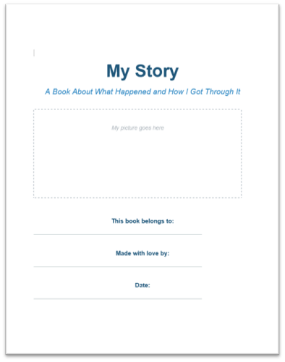
The full 8-chapter booklet with fill-in-the-blank prompts, writing lines, and picture boxes. Ready to print and complete together.
Completed Example
A fully worked example featuring a 26-year-old following a car accident and hospital visit. Shows caregivers how a completed booklet looks.
Download here: My Story completed example